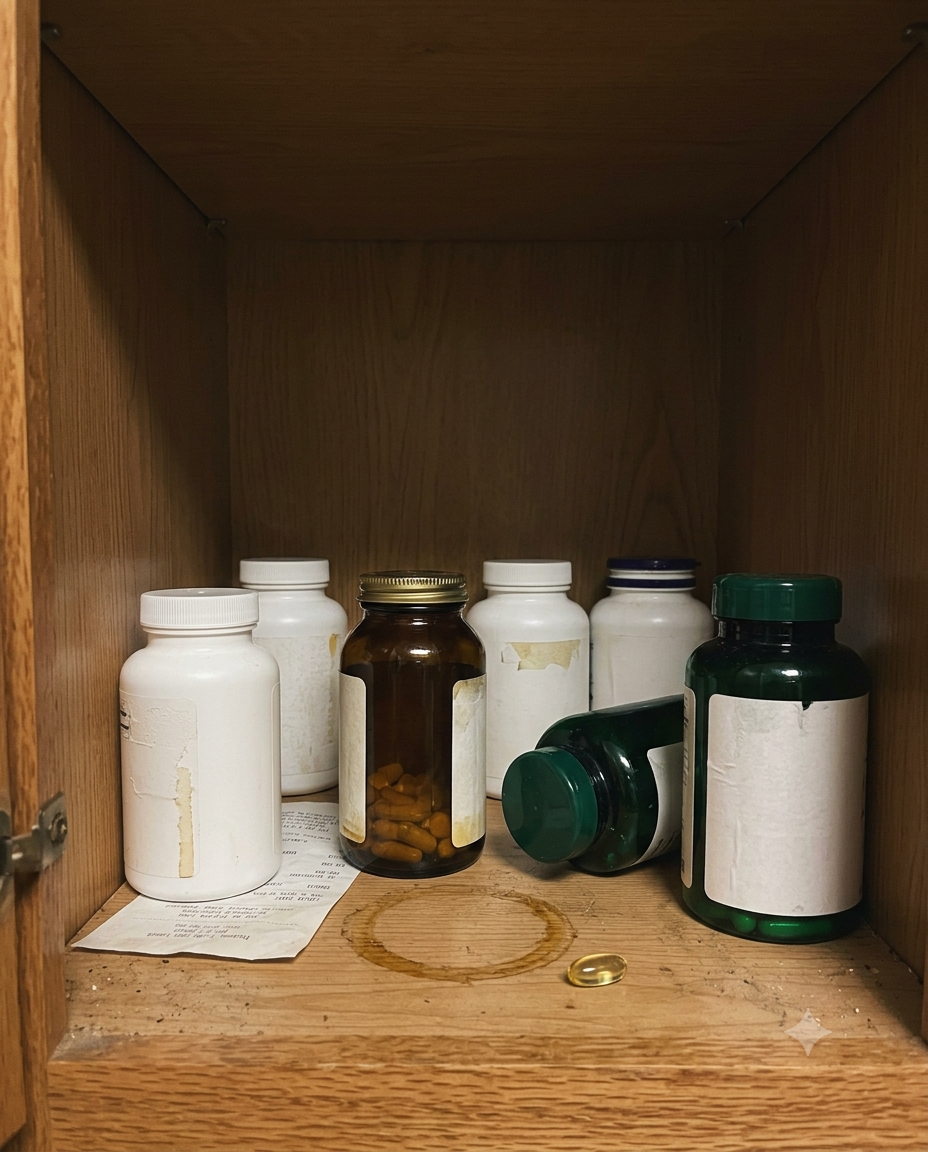




















Somewhere in your kitchen there is a shelf that tells the truth about supplements.
The multivitamin with a third of the bottle left, expired last spring. The probiotic that needed refrigerating, which is why it lives in a cabinet. The fish oil from the podcast. The magnesium from the other podcast. Each one arrived with a plan attached. Each plan lasted somewhere between eleven days and six weeks.
That shelf is not evidence that you lack discipline. It is evidence of a design flaw. Every bottle up there is a separate decision: a separate cap to open, a separate time of day to remember, a separate thing to run out of and reorder. Five bottles is five daily decisions, and daily decisions are exactly what busy lives shed first. The supplement industry keeps selling people more knowledge about what to take. The thing that actually fails is never the knowledge. It is the routine.
Which reframes the whole question. Not “what should I be taking?” The shelf proves you already know. The question is: what is the version of this that still happens on a Tuesday in November?
Start with the eating data, because it is public.
The CDC tracks how Americans actually eat, and the headline number has barely moved in a decade: only about one in ten adults meets the recommended daily vegetable intake. Nine in ten fall short, not of some optimizer's standard, of the baseline. And national nutrition surveys keep finding the same downstream story: large shares of adults under-consuming nutrients as basic as vitamin C, magnesium, and folate. Not exotic compounds. The basics.
Now the sentence a greens-powder ad is not supposed to contain: food fixes this better than powder does. A genuinely varied diet (vegetables at most meals, fruit, fermented foods, enough fiber) beats anything in a pouch, and if that describes your actual weeks, not your intended ones, you may not need this product at all. Nothing that follows overrides that.
What follows is for the other nine in ten.
AG1 Next Gen is one scoop of powder in cold water, once a day, and its honest job description is consolidation: a multivitamin, prebiotics and probiotics, and a spread of greens, superfoods, and antioxidants (75-plus ingredients) collapsed into a single sixty-second habit. One decision instead of five. One thing to run out of. The design bet is that a merely good routine you keep every day beats a perfect regimen that lives on the shelf of abandoned bottles.
Two things it is not, stated plainly. It is not a salad: one scoop carries about 2 grams of fiber, and no powder on earth substitutes for actual vegetables. The company's own line is that it complements a diet, and that framing is correct. And it is not your vitamin D source: meaningful D does not survive well in a powder like this, which is why D3+K2 comes as separate drops rather than being quietly overpromised inside the scoop.
Here is where this category gets genuinely uncomfortable, and where the checking comes in.
Greens are plants, and plants concentrate whatever is in their soil, including heavy metals. Independent testing of the greens-powder category has flagged products for exactly that, more than once, and most powders on the shelf carry no independent certification at all. You cannot see contamination, you cannot taste it, and a beautiful label says nothing about it.
The answer is not trust. It is certification you can look up. AG1 is NSF Certified for Sport, the standard strict enough that professional and Olympic athletes rely on it, because their careers end if a supplement contains something undisclosed. Certification means every batch is independently tested for contaminants, for banned substances, and for label accuracy: what the label claims is what the pouch contains. And the register is public: NSF maintains a searchable database of certified products. Look AG1 up before you buy. Look up whatever else you currently take while you are there. That search will teach you more about this category in two minutes than any ad can.
One more piece of label honesty, since checking is the standard being set: like most complex formulas, AG1's label discloses every ingredient but folds some individual amounts into blends. What the certification independently verifies is that the label is accurate to the pouch. If fully itemized dosing is your non-negotiable, that is a fair standard to hold; hold it knowingly.
On evidence: the Next Gen formula has been put through actual placebo-controlled trials, the largest a 12-week randomized, triple-blind study of 105 adults, showing improved nutrient biomarkers (70 percent of subjects increased red-blood-cell folate, 73 percent increased vitamin C) and measurable enrichment of healthy gut bacteria. Small studies by pharmaceutical standards. Real ones by supplement standards, where the norm is zero. Read them at the science page before deciding; they are short.
The practical facts: $79 a month as a subscription (about $2.60 a day) with free shipping, pause or cancel anytime, and a 90-day money-back guarantee. It is free of gluten, dairy, and artificial sweeteners, and it is HSA/FSA eligible for many plans. The company's own expectation-setting is worth repeating instead of inflating: research suggests up to 90 days to notice most benefits. Anyone promising you a transformed Tuesday by Friday is selling a feeling the data does not offer.
If you are pregnant, nursing, on medication, or managing a condition, this is a conversation with your doctor before it is a purchase; the ingredient list is long, and long lists deserve a professional read.
So here is the honest structure of trying it, and notice what the scoreboard is.
It is not a feeling. Feelings are noisy, and a product this broad works quietly or not at all. The scoreboard is the streak. Put the pouch next to the coffee maker, tie the scoop to something you already never skip, and count mornings. The shelf of abandoned bottles never made it past week six; that is the record to beat. At ninety days you will know two things the shelf could never tell you: whether this is the rare routine that survives your actual life, and whether you notice the difference the studies measured. The guarantee runs the same ninety days, so a failed experiment costs the effort and nothing else.
Ninety mornings. The streak is the scoreboard.
Start here:
https://drinkag1.com/products/greens-powder-pouch
P.S. Buy vegetables this week no matter what you decide here. The one-in-ten statistic is not waiting on a better powder; it is waiting on more plants on more plates, and no company selling a green drink honestly disputes that.
These statements have not been evaluated by the Food and Drug Administration. This product is not intended to diagnose, treat, cure, or prevent any disease. Consult your physician before beginning any supplement, especially if you are pregnant, nursing, taking medication, or have a medical condition. Individual results vary. NSF Certified for Sport® is a registered mark of NSF.